

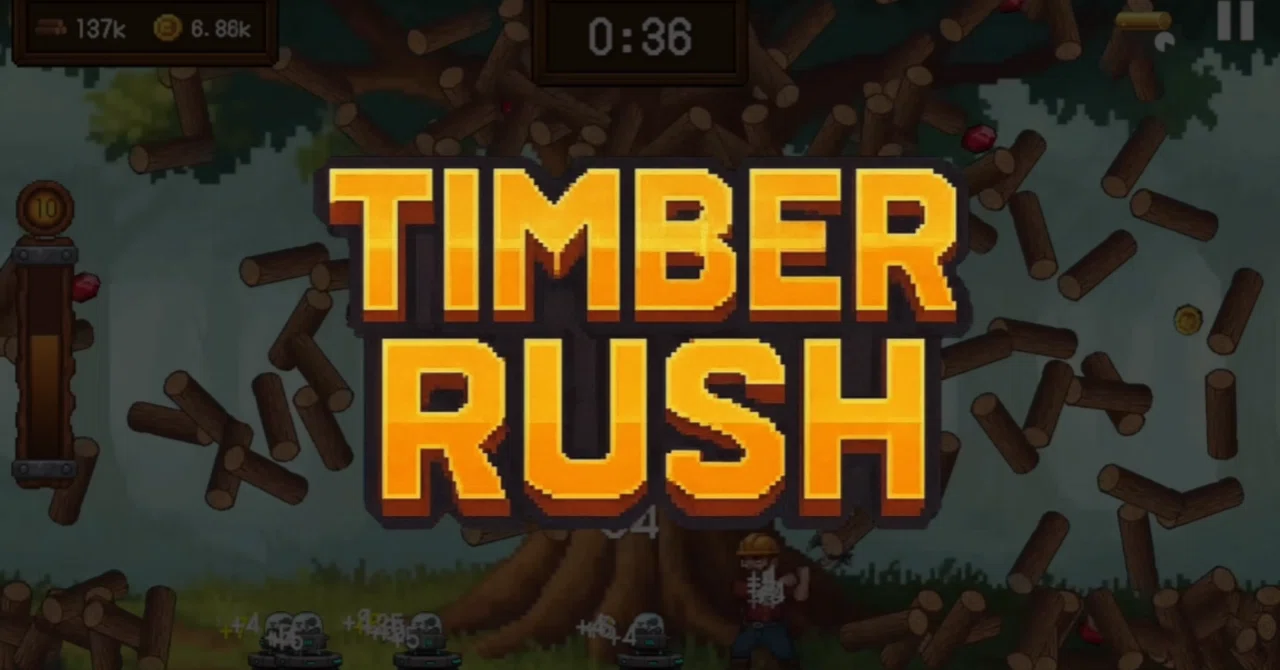
Incremental games are often built around a simple concept: perform a repetitive task, earn resources, purchase upgrades, and watch your progress snowball into something far larger than where you started. Timber Rush follows that formula closely, but manages to stand out thanks to its fast progression, roguelite elements, and satisfying upgrade systems.
At first glance, Timber Rush appears almost too simple. Players chop away at a massive tree, collect resources, and spend them on upgrades. However, beneath that straightforward gameplay loop lies a surprisingly engaging experience that keeps players chasing the next upgrade, the next unlock, and the next powerful combination.
A Simple Concept That Works
The core gameplay of Timber Rush revolves around harvesting resources from a gigantic tree. Every strike generates logs, currency, and various materials that can be invested into improving your character and future runs.
The game wastes little time introducing players to its progression systems. New upgrades become available frequently, ensuring there is almost always another goal to pursue. Early sessions quickly evolve from manually gathering resources into creating powerful builds capable of generating enormous amounts of wealth within minutes.
This constant sense of progression is one of Timber Rush’s greatest strengths. Players rarely feel stuck for long, especially during the opening hours.
Roguelite Progression Adds Depth
What separates Timber Rush from many traditional clicker games is its roguelite structure.
Rather than simply accumulating resources forever, players are encouraged to reset their progress in exchange for permanent bonuses and stronger future runs. These resets become an important part of the gameplay loop, allowing players to experiment with different upgrade paths and strategies.
Each run contributes to long-term progression, creating a satisfying cycle where every setback eventually leads to greater rewards. The result is a game that feels far more engaging than a standard idle experience.
Upgrades Are the Real Attraction
The upgrade system serves as the heart of Timber Rush.
Players can unlock a wide variety of bonuses, including automation features, resource multipliers, critical-hit boosts, companion abilities, and numerous passive effects. As more upgrades become available, different combinations begin to emerge, allowing players to create highly efficient resource-generating builds.
One of the game’s biggest strengths is how frequently it rewards players. New upgrades appear regularly, and many of them have a noticeable impact on gameplay. Watching a build suddenly explode in efficiency after unlocking the right combination creates some of the most satisfying moments the game has to offer.
By the mid and late game, the screen often becomes filled with resources, effects, and bonuses triggering simultaneously, creating the chaotic progression that incremental game fans often enjoy.
Where Timber Rush Struggles
Despite its strengths, Timber Rush is not without flaws.
The most noticeable issue is repetition. While the progression systems remain entertaining for a significant amount of time, the core activity never changes dramatically. Players who do not enjoy incremental or idle-style gameplay may find the experience repetitive after several hours.
Late-game progression can also become noticeably slower. Certain upgrades require substantial grinding, and some players may find the pace less rewarding compared to the rapid progression experienced during the opening stages.
The game’s presentation is also relatively basic. While functional and easy to understand, the visuals are clearly designed to support gameplay rather than impress players with cutting-edge graphics or complex environments.
Visuals and Audio
Timber Rush features a simple visual style that prioritizes clarity over realism.
Animations are straightforward, effects become increasingly flashy as progression advances, and the user interface remains easy to navigate throughout the experience. While the graphics will not be a selling point for most players, they successfully communicate the constant flow of resources and upgrades.
The audio complements the gameplay well enough, though it is unlikely to leave a lasting impression. Most players will likely remain focused on optimization and progression rather than the soundtrack itself.
Is Timber Rush Worth Playing?
For fans of incremental games, clickers, and roguelites, Timber Rush offers an enjoyable and addictive experience that delivers exactly what it promises.
The game successfully combines satisfying progression, meaningful upgrades, and roguelite mechanics into a package that is easy to learn and difficult to put down. While repetitive gameplay and late-game grinding may discourage some players, those who enjoy watching numbers grow and systems evolve will likely find plenty to enjoy.
Timber Rush does not reinvent the genre, but it executes its ideas effectively. Sometimes that is all a game needs to do.
Final Verdict
Timber Rush is a surprisingly entertaining incremental roguelite that understands its audience and delivers a rewarding progression loop from start to finish. Its simple premise hides a deep upgrade system and satisfying long-term progression that keeps players coming back for one more run.
Score: 8/10
If you enjoy clicker games, idle progression systems, and roguelite upgrades, Timber Rush is well worth adding to your collection.
Enjoy our updates? You can add GamingHQ as a preferred source in Google Search to see our articles more often.


